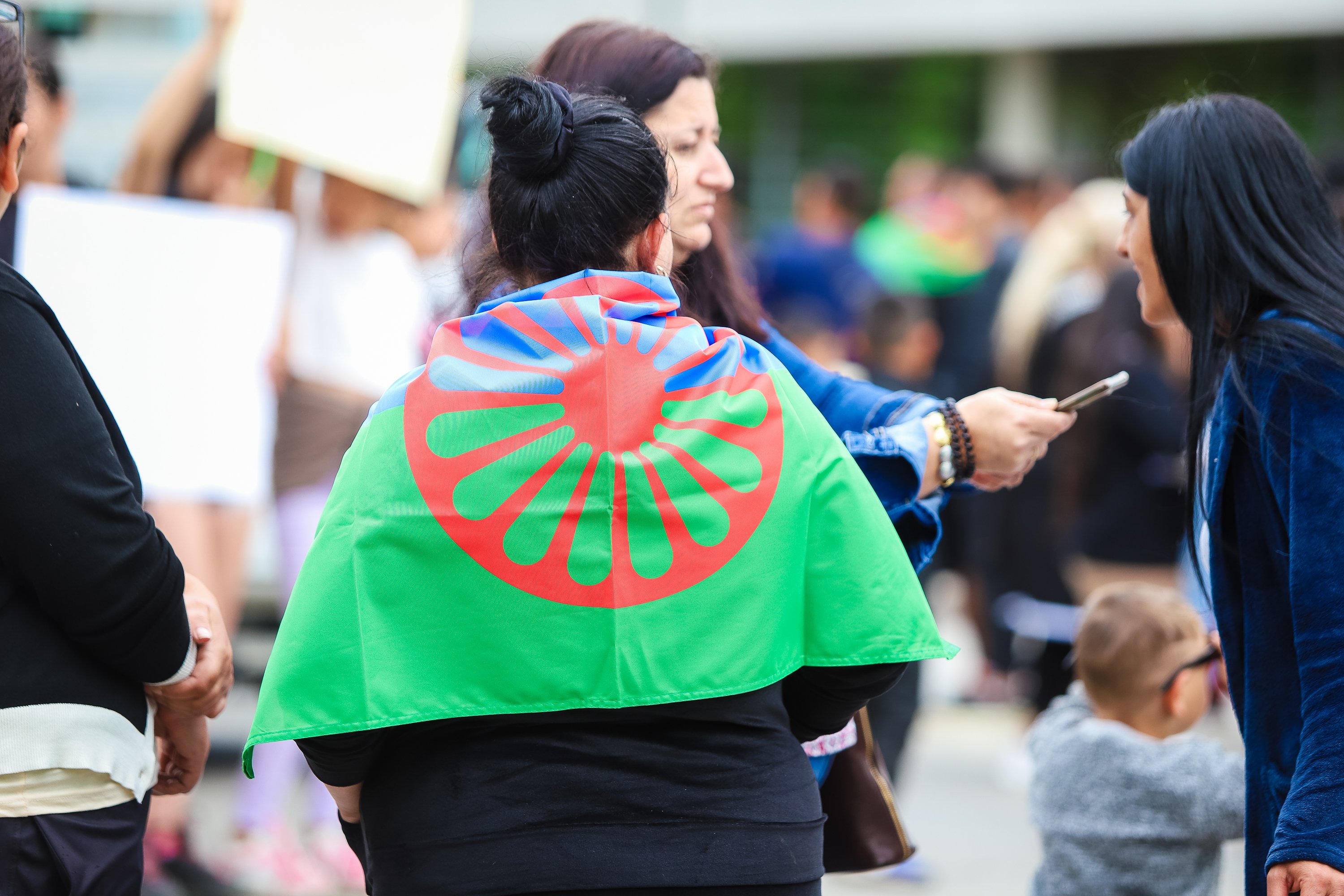
As Bulgaria confronts rising public frustration, the long-overlooked experience of Roma citizens reveals both the depth of the system’s failings and the potential the country wastes when it sidelines a community that could help stabilise its future.
Bulgaria is in the streets again—and once again, the country’s most revealing truth sits at the edge of the crowd. The protests over the draft budget come at a moment of rising costs, political fatigue and a growing sense that institutions no longer listen. Much of the debate centres on whether Roma citizens are participating. Some do, some don’t. But that is not the point. The real question is what Roma behaviour reveals about how power works in Bulgaria—and why this should concern anyone who cares about the country’s democratic future.
What people now shout in the streets—that institutions are unresponsive, protections selective, and the state present during elections but absent the day after—describes conditions Roma have endured for decades. The frustrations erupting in the square are not new. They are simply entering the mainstream. Understanding Roma behaviour is not about understanding “Roma politics”. It is about understanding how Bulgaria’s system functions—and who feels its failures first.
For more than thirty years, Bulgaria has run on a political operating system that pulls Roma into elections but keeps them out of decision-making. Parties across the spectrum have relied on intermediaries, identity-document barriers, welfare leverage and other tools to manage and mobilise Roma votes. These practices became routine, even normal. What the protests expose is that this model not only failed Roma—it weakened the system for everyone.
The frustrations in the square and the frustrations in Roma neighbourhoods were produced by the same operating logic, applied earlier and more intensely to Roma. The pattern of selective inclusion that shaped Roma political life now shapes how many other Bulgarians experience the state. The result is a simple, damaging truth: Roma help decide who wins yet barely appear in the institutions that govern afterwards. No democracy can function this way. And in a country whose population is declining faster than any other in the EU, excluding such a young and essential part of society is self-defeating.
Roma make up nearly 10 per cent of the population and a quarter of the youngest workforce yet hold less than 0.1 per cent of national decision-making posts. The economic loss from wasting this potential—estimated between 162 and 306 billion BGN over the next generation—drags down Bulgaria’s competitiveness, labour market and demographic survival. No country can thrive while sidelining a quarter of its future workers.
Throughout history, Roma have contributed to Bulgaria’s social and economic life—as craftsmen, workers, artists and neighbours—yet successive governments blocked them from political power. Early-20th-century voting restrictions, the shutdown of Roma organisations, communist-era repression and the post-1989 ban on ethnic parties all kept Roma visible as citizens but invisible as decision-makers. Census undercounts reinforced this invisibility. Roma sustained the country but were denied influence over it.
Yet Roma consistently chose stability. They never pursued separatism, never took up arms and never aligned with hostile powers. They defended Bulgaria during crises and supported its European path. Few groups in Europe have shown such loyalty to a state that offered so little political space in return.
After 1989, democracy and EU membership raised expectations. Rights expanded, investments arrived, and new programmes appeared. But the deeper structure did not shift. Funds were absorbed into local patronage networks. School segregation intensified. Evictions continued. Police operations expanded. Roma were consulted but rarely empowered. The gap between democratic promise and lived reality widened—for Roma and for many Bulgarians who also expected more.
The people in the squares and the people long ignored by institutions share more than they realise. Both face a system that appears only when it needs their votes and disappears when they need answers. Roma have lived with this for generations. Protesters are now experiencing it in fast-forward. The sooner these two worlds recognise their common ground, the harder it becomes for political actors to set them against one another.
Yet political actors on all sides are again trying to use Roma rather than engage them. Each camp wants their numbers but not their agency. Each is ready to blame them if turnout disappoints. Roma see this clearly. Their hesitation is not disinterest; it is a survival strategy shaped by decades of being treated as instruments, not partners. Until Bulgaria breaks this cycle, no protest—regardless of size—will shift the deeper equation.
Instead of addressing the underlying problems and legitimate grievances, those in charge create scapegoats to distract. Roma recognise these tactics instantly because they have lived with versions of them for generations. Protesters must see through these manoeuvres or risk fighting among themselves instead of the system that ultimately weakens everyone.
The truth is simple. When Roma have access to clear procedures, fair conditions and predictable institutions, participation rises, trust grows, and democratic processes strengthen for everyone. These are not vulnerabilities. They are assets—and Bulgaria needs them.
Roma have always stood with Bulgaria, and they could stand with these protests too—but only when intentions seem genuine and change seems possible. Their hesitation is not a rejection of the moment; it is a test of whether this time is different. Bulgaria now has a choice: keep a system that uses Roma when convenient or build a democracy that includes everyone shaping its future. If Bulgaria wants a different future, it must begin by changing who gets to shape the present.

Mensur Haliti
Vice President for Democracy and Network Development
The latest

The Conditional Belonging of Bulgaria’s Roma
Unregistered, Uncompensated, Unbroken

EU Budget Tracking Rules Name Roma but Still Cannot Say Whether Their Lives Improve, Roma Foundation for Europe says
Browse by category
Campaigns
Events
Facts
Press
Voices
For media inquiries:
[email protected]Sign up here so you don’t miss out on campaign updates, upcoming events and other news from the Roma Foundation for Europe and our network.
Sign up for our newsletter