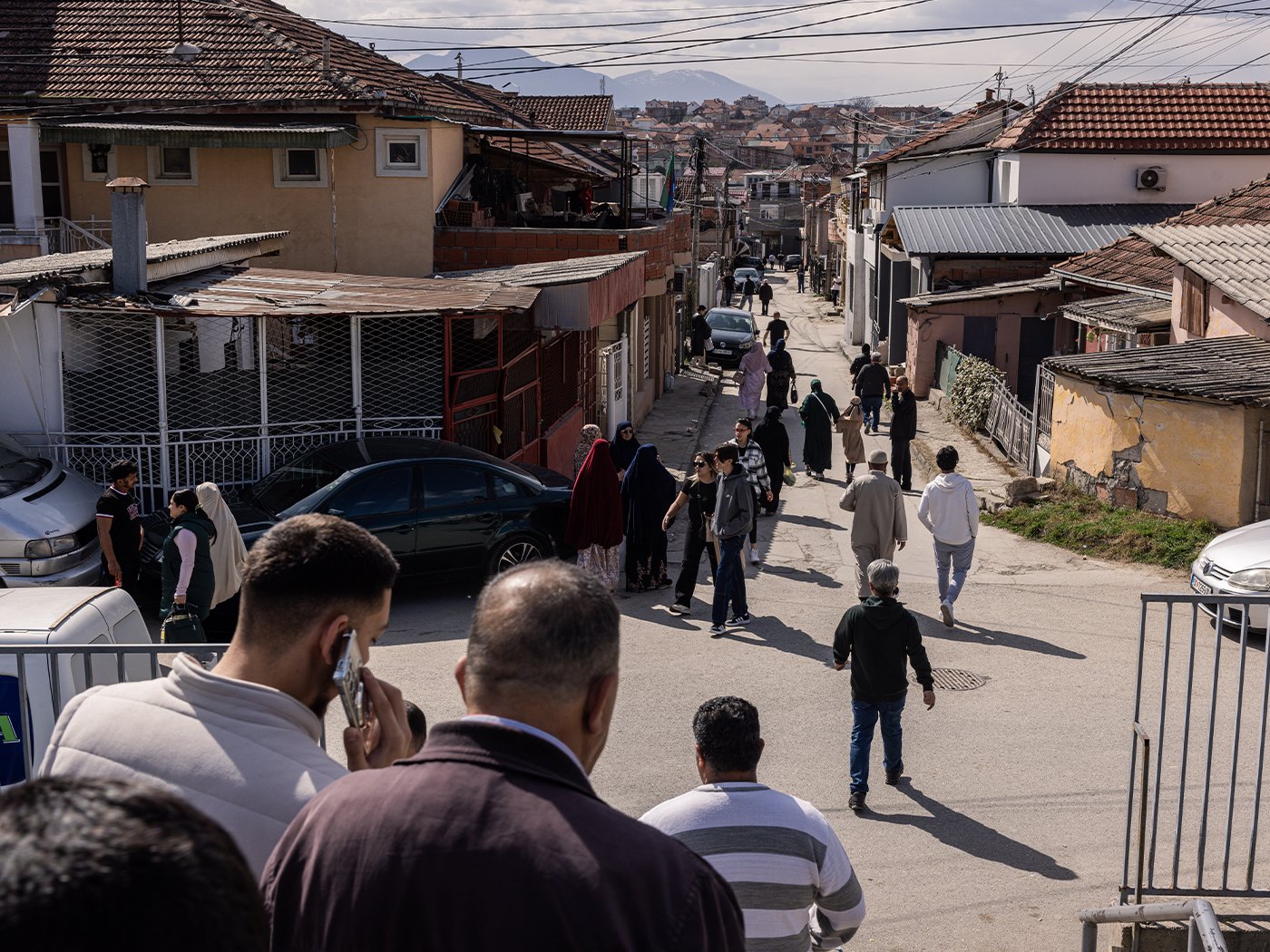
North Macedonia’s government is facing its biggest crisis yet: a fire trial, a missed EU deadline, a brain-trafficking investigation, a record drug seizure. It is no surprise that attention has shifted to Roma burning tyres.
IIn any normal week, any one of North Macedonia’s current crises would dominate the news cycle.
The country’s largest corruption trial is unfolding in Skopje, with 35 defendants—including two former ministers—charged over the nightclub fire that killed 63 teenagers last March. On 10 February, the government will miss a critical EU accession deadline it has made no serious effort to meet. Prosecutors have opened an investigation into the export of human brain tissue to the United States, triggered by documents from the Jeffrey Epstein case. And a five-ton marijuana shipment—the largest drug seizure in the region’s history—has been linked to political figures.
Instead, Macedonian media has spent days running wall-to-wall coverage of Roma protesters burning tyres.
This is not an accident. It is a choice.
Confiscation means economic collapse
Roma protesters blocked highways in several cities, demanding the return of vehicles confiscated under the new Safe City traffic enforcement system. Deployed in December, the automated camera network—operating without real-time human oversight—recorded 110,000 violations in its first 24 hours. Under recent amendments, vehicles can now be directly confiscated for a wide range of violations.
But for a community facing 73 percent unemployment and near-total reliance on informal work—scrap metal collection, recycling, street vending or informal taxi work—often far from their neighbourhoods and without meaningful public transport, confiscation does not mean inconvenience. It means economic collapse.
The protesters’ demands sound unreasonable until the trap is understood. North Macedonia’s own courts have confirmed that the state bears responsibility for leaving Roma without basic documentation, exposing them to statelessness and barriers to fundamental rights such as education, healthcare, employment and social protection. Without schooling, no driver’s licence. The same state that now demands compliance spent decades making compliance impossible.
The Interior Ministry has not responded to requests for dialogue. It has not proposed any pathway to compliance.
How leverage determines which demands matter
When truck drivers from four Balkan countries blockaded EU border crossings in late January—costing an estimated 100 million euros per day—governments negotiated immediately. Montenegro’s drivers lifted their blockade after a single meeting. The European Commission recognised professional drivers as a distinct category. The crisis was resolved within days.
When Roma blocked roads, the response was silence. No meetings. No proposals. No ministerial statements. “What followed instead were days of sensationalised coverage by a media ecosystem that often operates as a messenger for the state and the powerful, shaped by opaque state and party advertising that favours government-aligned outlets.”
The difference is leverage. Truckers can paralyse trade. Roma, with no representatives in parliament for the first time since 1989, paralyse nothing except the news cycle.
If there were political will, the Roma protests could end just as quickly. A 90-day grace period for documentation compliance would cost nothing. Emergency document assistance in affected municipalities—including processing IDs, birth certificates and residence confirmations—would require only staff reallocation. An adult education pathway for citizens who never completed primary school, a prerequisite for driver’s licences, could be announced in one press conference. A vehicle registration amnesty with reduced fees would likely increase tax revenue by bringing informal vehicles into the system.
These are not radical proposals. They are what any government would consider when facing unrest it wants to end. But the Mickoski government has floated none of them publicly. Resolution would require negotiation, compromise and the unglamorous work of governance. Most importantly, it would remove the story from the screen.
That is precisely the point. A solved crisis disappears from the news. An ongoing crisis stays on air, diverting attention from less comfortable truths.
The crises kept off-screen
The protests have unfolded amid a convergence of scandals that would normally dominate the agenda: a corruption trial, a looming EU accession deadline, a brain-trafficking investigation and the largest marijuana seizure in the region’s history. Any one of these stories could destabilise a government. Together, they mark its most dangerous week.
The fire trial implicates officials. The EU deadline splits nationalists from pro-Europeans. The brain investigation touches institutions. The drug seizure raises uncomfortable questions.
Roma protests, on the other hand, offer something none of the other stories do: a villain that unifies rather than divides the government’s base. They allow the government to cast itself as the defender of law and order, protecting the grievances of “real” Macedonians against a lawless minority demanding special treatment.
In reality, the parallels between the crises are stark. The prosecutor in the nightclub fire trial accused defendants of refusing to see danger that had been visible for years—a failure of duty that cost 63 lives. The same logic applies to Roma exclusion. The state saw missing documents, inaccessible education and impossible compliance. Yet it did not act.
Now the consequences of that neglect are burning on the highway. For the government, however, that is not a problem. It is a solution—as long as it can keep it on the air.

Mensur Haliti
Vice President for Democracy and Network Development
The latest

The Conditional Belonging of Bulgaria’s Roma
Unregistered, Uncompensated, Unbroken

EU Budget Tracking Rules Name Roma but Still Cannot Say Whether Their Lives Improve, Roma Foundation for Europe says
Browse by category
Campaigns
Events
Facts
Press
Voices
For media inquiries:
[email protected]Sign up here so you don’t miss out on campaign updates, upcoming events and other news from the Roma Foundation for Europe and our network.
Sign up for our newsletter